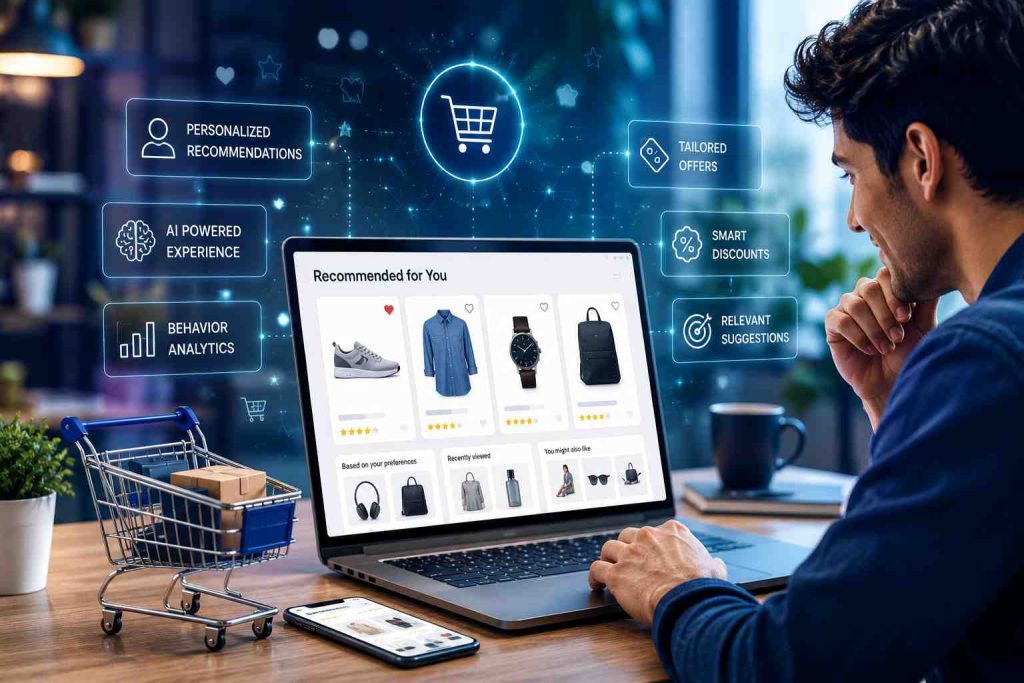
The current market economy starts with online brands, especially focusing on e-commerce business growth. When you visit The Dubai Mall in the evening, you see many different shops on the same street, like a Chanel store, a Damas jewelry shop, a local Emirati shop, and a Chinese electronics store. Every shop attracts different people with different wishes.
This happens in real life, and online shopping brands need to do the same thing on their websites. This is why e-commerce personalization in Dubai businesses need to use online because Dubai does not have just one type of customer. There are many different shoppers living in the same city.
This is exactly why the smartest AI e-commerce Dubai companies have stopped treating this as a simple extra feature and now treat it as their main system. Most blogs miss an important point: the tricks that work in a busy and mixed market like Dubai will also work anywhere else in the world, like London or Los Angeles. If you can make online shopping personal and easy for Dubai shoppers, you can easily do it anywhere. This article explains why and shares useful tips that most agencies never tell you.
The Data Behind E-commerce Personalization in Dubai Growth
The UAE online market is growing fast, moving from about USD 12.3 billion in 2026 to more than USD 21 billion by 2031 with an 11% yearly jump. Right now, over 11 million people shop online here, which is nearly 96% of the population. Since almost everyone uses a smartphone, more than 75% of people browse and shop directly from their phones.
Even with this huge mobile growth, cart abandonment in the UAE sits at 78%, which is higher than the worldwide average of 70%. This proves that local shoppers leave a website quickly if the shopping experience feels generic, slow, or not useful to them.
On the personalization side specifically, 71% of consumers globally now expect tailored interactions, 76% get frustrated when they don’t get one, and personalized recommendations lift e-commerce revenue by 10-30% on average. Put simply, the appetite for online shopping in this market has never been bigger, but neither has the competition for a shopper’s attention.
1. Why Generic Shopping Experiences Fail (Stop Showing Everyone the Same Thing)
Here’s a fact most e-commerce blogs won’t mention with real numbers: expatriates make up close to 90% of Dubai’s population, and the wider UAE is home to over 200 nationalities. Indians alone make up close to 38% of the UAE’s total population, the single largest community in the country. That means your “average customer” doesn’t exist. The person browsing your store at 9 PM could be an Emirati national who shops in Arabic and expects same-day delivery, a European expat comparing prices against their home country, an Indian professional sending gifts back home, or a tourist buying something they saw on a billboard on Sheikh Zayed Road an hour earlier.
A generic, one-size-fits-all storefront treats all of these people identically. And the data backs up why that fails:
- UAE e-commerce cart abandonment sits around 78%, well above the global average of roughly 70%
- Mobile accounts for over 75% of web traffic in the UAE, and with smartphone penetration above 99%, a store that isn’t personalizing for mobile-first browsing is losing the majority of its audience by default
- Repeat purchase rates stay flat when there’s no sense of “this store gets me”
- Zero emotional loyalty forms, which matters enormously in a market where word-of-mouth and social proof (via WhatsApp groups, family networks, and influencer culture) drive far more purchases than paid ads do
Here’s the unique insight most people miss: in Dubai, language and currency personalization alone can outperform product recommendations. A store that automatically detects whether to show AED or USD, switches between Arabic and English based on browser signals, and adjusts imagery for cultural context (modest fashion during Ramadan, for example) often sees stronger conversion lifts than stores that only personalize product suggestions. Personalization isn’t just “what do they want to buy” — in a B2C and B2B market like Dubai, it starts with “how do they want to be spoken to.”
And this isn’t a Dubai-only lesson. Whether you’re selling in Toronto, Berlin, or Sydney, your customer base is more layered than your analytics dashboard suggests. Dubai just makes the diversity impossible to ignore — which is exactly why brands that master personalized shopping experience UAE strategies tend to build systems flexible enough to work anywhere.
2. How AI Understands What Your Customers Want
Most articles describe AI personalization as “tracking clicks and showing similar products.” That’s the surface-level version. Here’s what’s actually happening underneath, and what the smartest AI-powered online store UAE brands are doing differently:
- Browsing Behavior Analysis — Beyond just clicks, modern AI models track dwell time, scroll depth, and even hesitation patterns (like hovering over a size chart or return policy link) to infer intent before a customer even adds something to their cart.
- Purchase History Patterns — AI doesn’t just look at what was bought, but when. A Dubai customer who buys skincare every 45 days isn’t just shown “similar products” — a well-built system predicts the exact week they’ll be ready to reorder and times the offer accordingly.
- Real-Time Personalization — This is where most stores still fall short. True real-time personalization means the homepage a customer sees at 8 AM (commute browsing) can look different from what they see at 10 PM (considered purchase browsing), because intent shifts by time of day — a pattern that’s especially pronounced in Dubai’s work culture, where lunch breaks and post-Maghrib evenings are peak mobile shopping windows.
- Predictive Analytics — This is the piece almost nobody talks about: event-based prediction. Dubai’s shopping calendar isn’t just “holidays” — it’s Ramadan (a full month of shifted shopping hours and gifting behavior), the Dubai Shopping Festival, UAE National Day, Eid, and even the start/end of the school year for the massive expat parent population. AI models trained on generic Western retail calendars completely miss these patterns. A model trained specifically on Dubai Shopping Festival e-commerce marketing data will outperform an off-the-shelf AI tool every single time.
The business case for all this isn’t theoretical. 98% of leading marketers say personalization directly contributes to profitability, and in a market where UAE Pass’s single sign-on has already lifted first-time online conversion by as much as 40% purely by cutting checkout friction, Dubai shoppers have effectively been trained to expect frictionless, relevant experiences — and they hold every other store to that same standard.
There’s also a second layer to this that’s almost never discussed: voice and language behavior. A meaningful share of Dubai residents use voice assistants weekly, switching fluidly between Arabic and English, sometimes within the same sentence. An AI personalization system that only recognizes clean, single-language search queries misses a large chunk of genuine buyer intent. Brands that train their systems to recognize mixed-language and transliterated search patterns — the way people actually type and speak here — end up capturing demand that competitors simply never see in their analytics.
3. The Power of “Customers Also Bought” Recommendations
Every e-commerce blog covers “Customers who bought this also bought…” as if it’s a simple plug-and-play feature. It’s not — and in Dubai specifically, it behaves differently than in most Western markets, for a reason almost nobody discusses: gifting culture.
A huge share of e-commerce activity in Dubai isn’t self-purchase — it’s gifting. Whether it’s Eid gifts, wedding season purchases (UAE weddings are famously elaborate), or corporate gifting between businesses, a large percentage of “Customers also bought” clicks in this market lead to a second transaction for someone else entirely, not an upsell for the original buyer. Brands that recognize this and design their recommendation engine around gift bundles, rather than just “related products,” consistently see stronger performance than those copying a generic Amazon-style layout.
Here’s why this feature matters, backed by real numbers:
- Higher Average Order Value (AOV) — Personalized recommendations increase e-commerce revenue by 10-30% globally, and Dubai’s high average spending power means shoppers are more willing to add a complementary item once already committed to buying
- Stronger purchase intent signals — Shoppers who click on a recommendation are roughly 4.5x more likely to complete a purchase than those who don’t, according to Salesforce research, making recommendation placement one of the highest-leverage design decisions on a product page
- Reduced cart abandonment — Relevant, well-timed recommendations at checkout have been shown to meaningfully cut cart abandonment, which matters enormously in a market where UAE abandonment already runs close to 78%
- Time savings — for Dubai’s large population of busy professionals and dual-income households, frictionless discovery matters more than browsing depth
There are three main formats — “Frequently bought together,” “You may also like,” and purchase-pattern-based suggestions — and each targets a different psychological trigger. There’s also a seasonality layer to this that’s rarely discussed outside the region. During Ramadan, recommendation engines that shift from individual products to curated “iftar gift sets” or “family bundle” logic tend to see conversion rates that generic product-pairing algorithms simply can’t match, because the underlying purchase behavior itself has changed for that month. A product recommendation engine Dubai businesses build with this seasonal flexibility baked in — rather than a static, year-round logic — captures revenue that a one-size-fits-all recommendation model leaves on the table.
4. How to Turn One-Time Visitors Into Loyal Buyers
Acquiring a first-time customer in Dubai is genuinely expensive — the market is saturated with global marketplaces, regional players, and a constant stream of new DTC brands entering via free zones. So the real ROI doesn’t come from that first sale. It comes from what happens after it.
Post-Purchase Personalized Follow-Up — Skip the generic “thank you for your order” email. Send something tied to what they actually bought — usage tips, styling guides, or a genuinely relevant next suggestion. This single change alone often outperforms entire retargeting ad budgets.
Personalized WhatsApp & Email Campaigns — Here’s a detail almost no international blog mentions with real numbers: an estimated 90% of UAE smartphone users open WhatsApp daily, the highest penetration of any major market globally. Well-run WhatsApp Business campaigns in the UAE routinely see open rates near 98%, and Click-to-WhatsApp Ads have been measured delivering 3-8x return on ad spend. Cart abandonment reminders and personalized offers sent this way consistently outperform email in this market, simply because it mirrors how people already communicate with businesses, friends, and family here.
Loyalty Programs with a Personal Touch — Generic points systems feel transactional. What works better for customer loyalty e-commerce Dubai brands is preference-based rewards: early access to a category a customer already buys from repeatedly, or a birthday offer that respects both Gregorian and, where relevant, cultural calendars.
Retargeting Ads That Feel Relevant — Dubai has one of the highest digital ad spends per capita in the region, which also means ad fatigue is real. Retargeting that shows a product a shopper genuinely engaged with — rather than a generic banner — is the difference between “helpful reminder” and “annoying ad” in a market that’s already saturated with paid media.
Anniversary & Milestone Recognition — This goes beyond birthdays. Recognizing the anniversary of someone’s first purchase, or timing an offer around a major cultural moment like Eid or DSF, creates a sense of being remembered — something that builds real loyalty rather than just repeat transactions driven by discounts alone.
Get this combination right, and something interesting happens: a one-time Dubai shopper doesn’t just come back — they start recommending your brand inside tight-knit expat and local community networks, which is often more valuable than any paid channel, given how community-driven purchasing decisions are in this city.
5. Want Your Own Smart E-Commerce Store in Dubai? Here Is How We Can Help You Build It
This is not just theory. It is the real strategy used by top online stores in a market that is set to double by 2031. However, building smart personalization for Dubai requires more than just a basic plugin. You need a system that truly knows local habits, such as the regional cultural calendar, bilingual shoppers, WhatsApp communication, and gifting trends. To get this right, you need a team that understands both the technology and the local market.
That’s exactly where Bridges Creatives comes in. We build smart e-commerce store Dubai businesses can actually rely on — combining AI-powered personalization with a real understanding of how people in this market shop, communicate, and make decisions.
We can help you with:
- Custom AI recommendation systems tuned for Dubai and UAE shopping behavior — not generic, imported logic
- Customer data analytics dashboards that track what actually matters in this market
- WhatsApp Business API and email marketing automation built around how Dubai shoppers actually communicate
- Bilingual, culturally-aware personalization (Arabic/English, AED-first pricing, seasonal calendar awareness)
- A complete, scalable AI-powered online store UAE platform designed to grow with your business
Whether you’re launching a brand-new store in Dubai or want to bring real personalization into your existing platform, contact us today — and let’s build a shopping experience that doesn’t just work for “average customers,” because in Dubai, there’s no such thing.
Get in touch with Bridges Creatives today and turn your Dubai e-commerce store into a brand people actually remember.